
Structures Built for Industrial Loads
Welding and Fabrication in Bossier City for custom equipment mounts, structural repairs, and component modifications unavailable as standard products
Standard equipment brackets and support structures rarely accommodate the actual field conditions encountered during installations where piping interferes with mounting locations, floor elevations don't match design assumptions, or existing infrastructure requires custom adapters to integrate new components. Welding and fabrication services from Redline Precision Group address these gaps across Bossier City industrial sites by building brackets, modifying equipment frames, and repairing structural damage to pump bases, skid frames, and support steel. The work ranges from simple angle iron brackets for cable management to complex structural modifications that redistribute loads around corroded or damaged sections of existing equipment.
Field welding happens on-site where equipment cannot be moved, while shop fabrication handles components that benefit from controlled positioning and access to heavy material handling equipment. Both approaches require understanding load paths, material properties, and how heat input during welding affects base metal strength and dimensional stability in finished structures.
Schedule a consultation to review fabrication requirements and determine whether shop or field work makes sense for your specific project constraints.
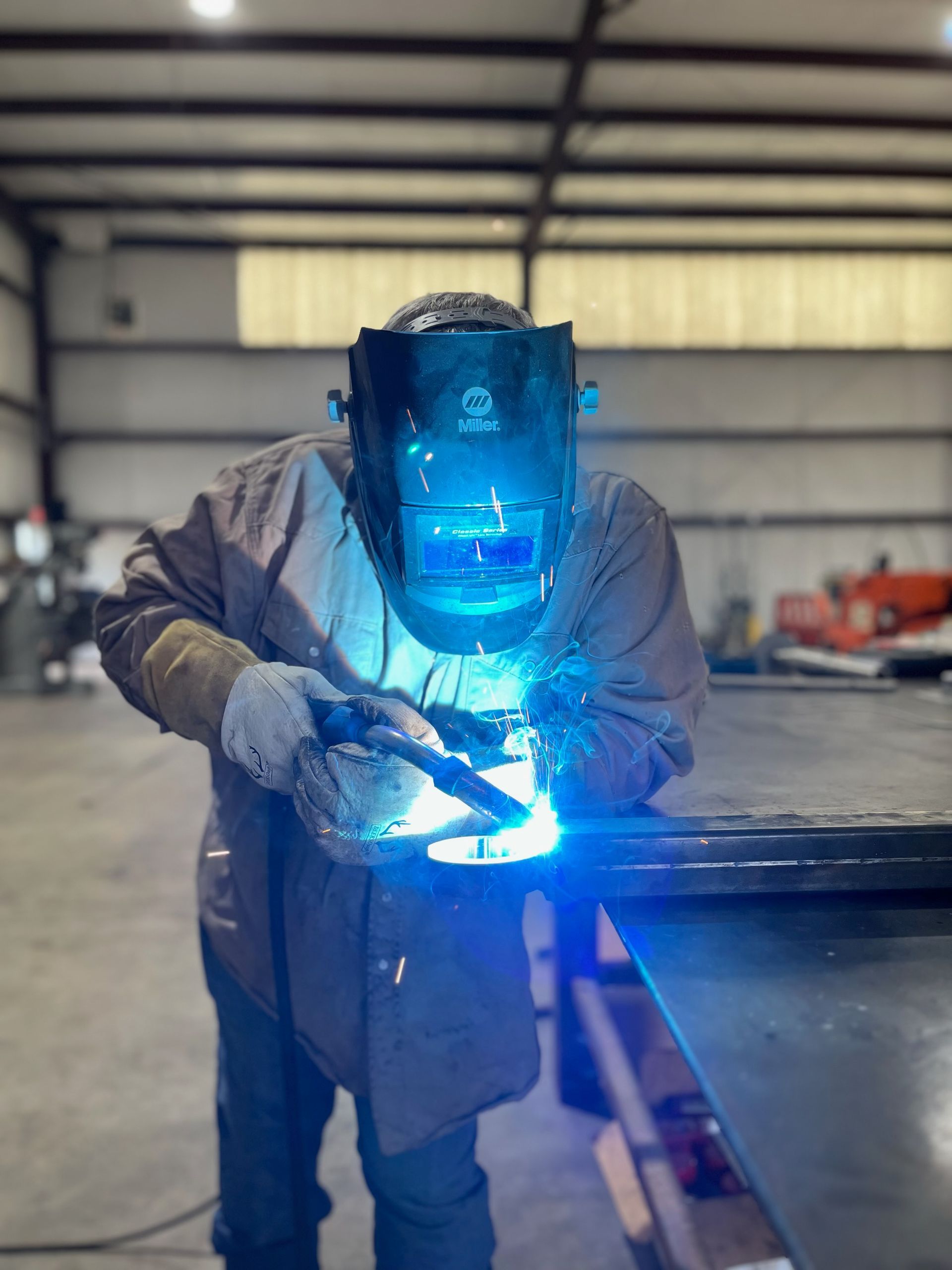
What Strong Fabrication Involves
Fabrication begins with material selection based on load requirements, environmental exposure, and compatibility with existing equipment, followed by cutting, fitting, and tack welding to verify alignment before final weld passes lock everything in position. Welding procedures vary depending on whether base metals are carbon steel, stainless steel, or dissimilar materials requiring specific filler metals and preheat protocols to prevent cracking or brittle weld zones that fail under cyclic loading.
Finished structures support equipment loads without deflection or vibration, welded joints show consistent penetration and fusion without porosity or undercut defects, and painted or coated surfaces resist corrosion in humid or chemically aggressive environments. Custom brackets align bolt holes correctly so components install without forcing fasteners or bending mounting tabs, and structural repairs restore original load-carrying capacity rather than creating stress concentrations that shift failures to adjacent areas.
Repair and rebuild work extends to pumps and gearboxes where casting damage, worn bearing journals, or broken mounting ears can be restored through careful welding and machining rather than scrapping expensive housings. These repairs require precision to avoid introducing heat distortion that throws components out of alignment or weakens pressure-containing sections.
Questions Before Starting Your Project
Welding outdoors in Bossier City requires controlling moisture contamination on base metals and filler materials, since humidity accelerates rust formation on prepared surfaces and introduces hydrogen into weld pools that causes delayed cracking in high-strength steels.
What welding processes are used for different applications?
Stick welding handles heavy structural work and field repairs where portability matters, MIG welding provides faster deposition on clean materials in controlled environments, and TIG welding delivers precision on thin materials or critical joints requiring high quality and minimal distortion.
How are custom brackets designed without engineering drawings?
Fabricators take field measurements, evaluate load directions and magnitudes, and design structures based on standard practices for material sizing and connection details, though complex or safety-critical applications may require formal engineering review.
When should damaged components be repaired versus replaced?
Repair makes sense when replacement parts are unavailable, lead times are unacceptable, or the damaged component is part of a larger assembly that would require extensive disassembly to replace, provided the damage hasn't compromised structural integrity beyond what welding can restore.
What determines whether work happens in the field or shop?
Field fabrication suits situations where equipment is too large to move, downtime prevents removal, or installation must happen around existing structures, while shop work allows better access, controlled positioning, and use of heavy tools for complex fabrication and machining operations.
Why do some welds fail shortly after repair?
Weld failure typically traces to inadequate joint preparation, incorrect filler metal selection, insufficient penetration, or base metal contamination, and also occurs when welded joints are placed in service before cooling to ambient temperature or when post-weld heat treatment is required but skipped to save time.
Custom fabrication solves installation problems and extends equipment life when standard parts don't exist or don't fit actual field conditions. Redline Precision Group handles both shop fabrication projects and urgent field repairs—contact us to discuss specific welding and fabrication needs for equipment modifications or structural repairs.